The History of BlueSMiRF

Today, we are going to look back 20 years to learn the origins of our BlueSMiRF product line.
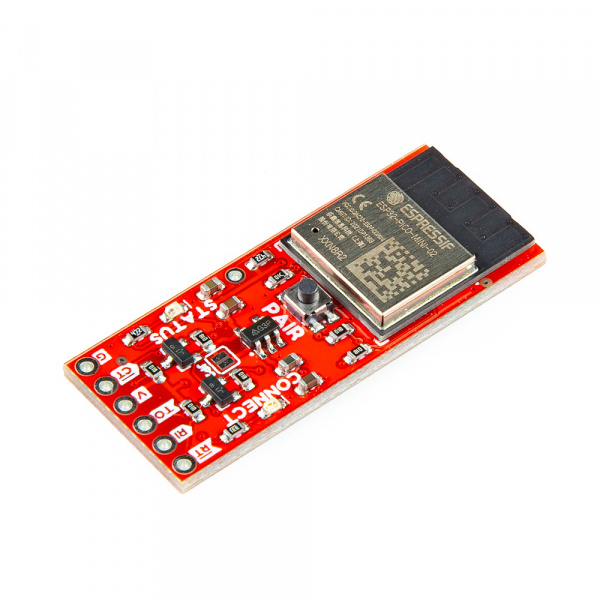
The BlueSMiRF product line is a series of wireless Bluetooth® serial links that recently celebrated is celebrating its 20th anniversary this month! The SparkFun BlueSMiRF v2 utilizes Espressif's ESP32 Pico Mini for wireless communication and is available in multiple variants, featuring PTH pins, male headers, or a JST connector. Operating as a serial data link, it provides a functional wireless substitute for hardwired connections between boards.
BlueSMiRF provided hardware hackers in the 2000s one of the first ways affordably incorporate Bluetooth into their projects. So today, we are going to take an excerpt from the BlueSMiRF v2 guide, and take a look back at some of SparkFun's past. Yup, it's Retrosparktive time!
The Original BlueSMiRF
Back in April 2005, we released the original BlueSMiRF (Bluetooth Serial Miniature RF) Link, which featured BlueRadio's WML-C40AH Bluetooth modems. It was released in two variants that came with either a 4-pin header on the basic BlueSMiRF or a 6-pin header on the extended BlueSMiRF, using the following pin configuration (CTS)/PWR/GND/TX-O/RX-I/(RTS). Canada loved them...


Basic BlueSMiRF
Extended BlueSMiRF
Silver, Gold, and Mate Header
Eventually, the Bluetooth modems manufactured by BlueRadio were discontinued and we transitioned to the RN-41 and RN-42 modules from Roving Network.
Gold vs Silver
The primary difference between the RN-41 and RN-42 modules was their range/transmit power. The BlueSMiRF Gold featured the RN-41, a class 1 Bluetooth module that had a range of 100m, but utilized more power. Meanwhile, the BlueSMiRF Silver featured the RN-42, a class 2 module with lower power consumption and a range limited to 10m.


BlueSMiRF Gold (RN-41)
BlueSMiRF Silver (RN-42)
Mate Header
With this revision, we also settled on a 6-pin layout to breakout the flow control pins of the serial interface. Additionally, in response to the growing popularity of miniaturized development boards, like the Arduino Pro and Pro Mini, we introduced a new variant with a compatible pin layout. The BlueSMiRF Mate variants had a pin layout (GND/CTS/VCC/TXO/RXI/RTS) that matched the USB-to-Serial adapters that were used to program and interface with the development boards. This allowed users to easily extend the capabilities of their board with the BlueSMiRF Mate.


A comparison of the pin layouts between the Bluetooth Mate and regular BlueSMiRF.
BlueSMiRF Mate connected to the headers for the serial programming interface of the Arduino Pro.
BlueSMiRF v2
Just as the Bluetooth modems from BlueRadio were discontinued, production of the modules from Roving Network also ceased and in 2021 we sold the last of the BlueSMiRF Gold and Silver. Fast forward to January 2024 and the BlueSMiRF has arisen once more!
$10.95
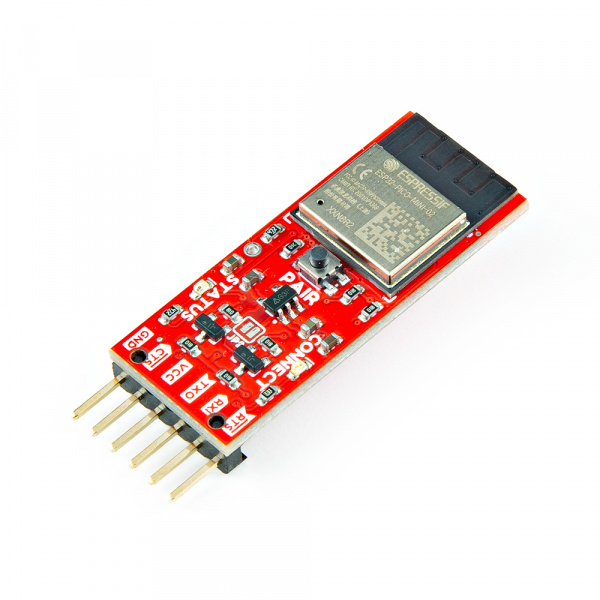
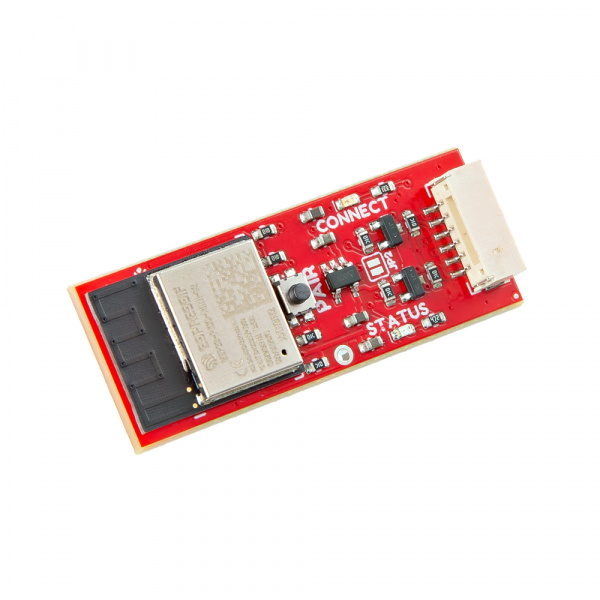
The new BlueSMiRFs v2 features a few upgrades:
- Features an ESP32-PICO-MINI-02 module programmed with our open-source firmware.
- Easily update the firmware Over-the-Air or through the serial interface.
- Remotely configure the settings with a simple AT-command set.
- We have three variants with different connections to simplify hooking up the BlueSMiRF to your project.
- The PTH pad and male header variants have fully, adopted the pin layout from the Bluetooth Mate.
RTS/RXI/TXO/VCC/CTS/GND.- Pin labels are now provided on both sides of the board.
- On the JST variant, the pin layout and JST connector matches the serial radios.
- The PTH pad and male header variants have fully, adopted the pin layout from the Bluetooth Mate.
- A user button has been added to simplify pairing, triggering various modes of operation, and resetting the factory defaults.
- Upgraded the voltage regulator to the APA2112K 3.3V, 600mA for increased performance.