How Higher Education Is Using XRP to Expand Education in Robotics & Automation

Some pretty interesting things are happening with XRP in colleges and universities - from teaching advanced engineering concepts and developing new applications to running youth programs and supporting educators.
When we talk about the Experiential Robotics Platform (XRP), much of the conversation naturally centers around middle- and high-school classrooms. But here's the thing: XRP is being adopted in colleges and universities for a variety of uses.
Universities are using the platform to teach advanced engineering concepts, experiment with new applications, provide STEM and Robotics outreach to younger students, and even help teachers take new technology back to their classrooms.
There isn't one "right" way for a university or college to use XRP; here are five very different approaches.
WPI: Where Most of This Started
It's hard to talk about XRP and higher education without starting with Worcester Polytechnic Institute (WPI).
WPI has been central to XRP from the beginning. Developed through a collaboration between WPI and DEKA Research & Development, XRP grew out of a pretty ambitious idea: How can we make meaningful, hands-on robotics education available to more students across the globe?
Based on some early R&D from Brad Miller, Senior Fellow at WPI, WPI and DEKA launched the beta XRP at the 2022 FIRST Global Challenge, where nearly 200 kits were distributed to teams from around the world. Based on the excitement and feedback from the teams, they knew they were ready to scale - this is when they invited SparkFun and DigiKey (DigiKey has developed awesome XRP Conent) to join the team to manufacture and distribute XRP at a larger scale.
Today, XRP maintains WPI's initial focus on expanding access to high-quality STEM education and project-based learning. WPI developed and continues to maintain the:
- Official XRP Getting Started Course
- Curriculum for middle- and high-school educators
- Technical Discourse Forum
- WPILib resources for FIRST Robotics teams
WPI also uses XRP to support global and community outreach. In addition to using XRP for summer camps and outreach workshops for younger students, it is used in several IQPs (Interactive Qualifying Projects) - including work students are doing in Paraguay, Morocco, and Honduras!
It's a great example of what happens when a university takes the engineering and project-based learning happening on its own campus and asks, "How can we make this available to everyone else?"
Cornell Systems Engineering Program: Beyond Introductory Robotics
Instead of treating XRP strictly as an introductory robotics platform, Cornell Duffield Engineering is using it to dig into some considerably more advanced engineering concepts. Students are using a relatively approachable robotics platform to explore many of the same technologies behind autonomous systems and modern robotics.
The Cornell Duffield Systems Engineering Program uses XRP in courses like "Model Based Systems Engineering," "Integration Verification & Validation," and "Systems Engineering Management for Virtual Teams," which have not only on-campus students but also over 100 professional students from top companies such as Lockheed Martin, Boeing, ASML, Cummins, and dozens more every year. The XRP provides an engaging platform that opens the doors to sensors, actuators, I2C and SPI communications, Wi-Fi and Bluetooth, signal processing, computer vision, control algorithms, and systems integration.
Cornell students have truly pushed the limits of the platform and have developed fun, inspiring projects and tutorials that demonstrate the expandability of the platform - both mechanically and electronically. This video highlights just a few of the projects.
Finally, students from the Cornell Systems Engineering Program have engaged with the platform and XRP partners to experience end-to-end product development. They collaborated with a team from University of Idaho to develop and go to market with the AgXRP, which uses the same controller board as the robot, but is an autonomous watering system that can be used in classrooms to teach precision agriculture.
We particularly like this model because students can experiment with advanced engineering concepts and then turn their developments into projects and resources that make those same technologies more accessible to a wider audience.
CU Boulder: On-Site Camps for High School Students
The University of Colorado Boulder's Science Discovery program uses XRP in its Computer Science and Robotics program for students in grades 9–12. It also delivers XRP camps out of the BTU Lab, part of the ATLAS Institute.
Students assemble their own SparkFun XRP and then jump into robot motion, sensors, programming, and control. They work through hands-on experiments before teaming up to design, build, and demonstrate robot projects of their own.
And there's a pretty great bonus: they get to take their XRP home.
For a high school student, this isn't just a robotics activity. They're getting to spend time on a university campus, work with engineering and computer science concepts, build something themselves, and get a glimpse of what continuing down a STEM path could look like.
For universities thinking about summer camps, recruitment, community engagement, or simply getting more young people excited about engineering, that's a pretty compelling model.
New Hampshire Community Colleges: Students Building Robots for Students
Through a statewide initiative, community colleges including Manchester, Lakes Region, White Mountains (CTE Center), and Great Bay became XRP fabrication sites, giving college and CTE students hands-on manufacturing experience while helping produce thousands of XRP kits for middle and high school classrooms across the state.
Governor Sununu approved this program in 2024 and it rolled out to schools in 2024-2026. The program is a stellar example of how higher ed and K-12 can be vertically integrated to provide meaningful educational experiences and authentic work-force development that has regional impact.
Minnesota State University
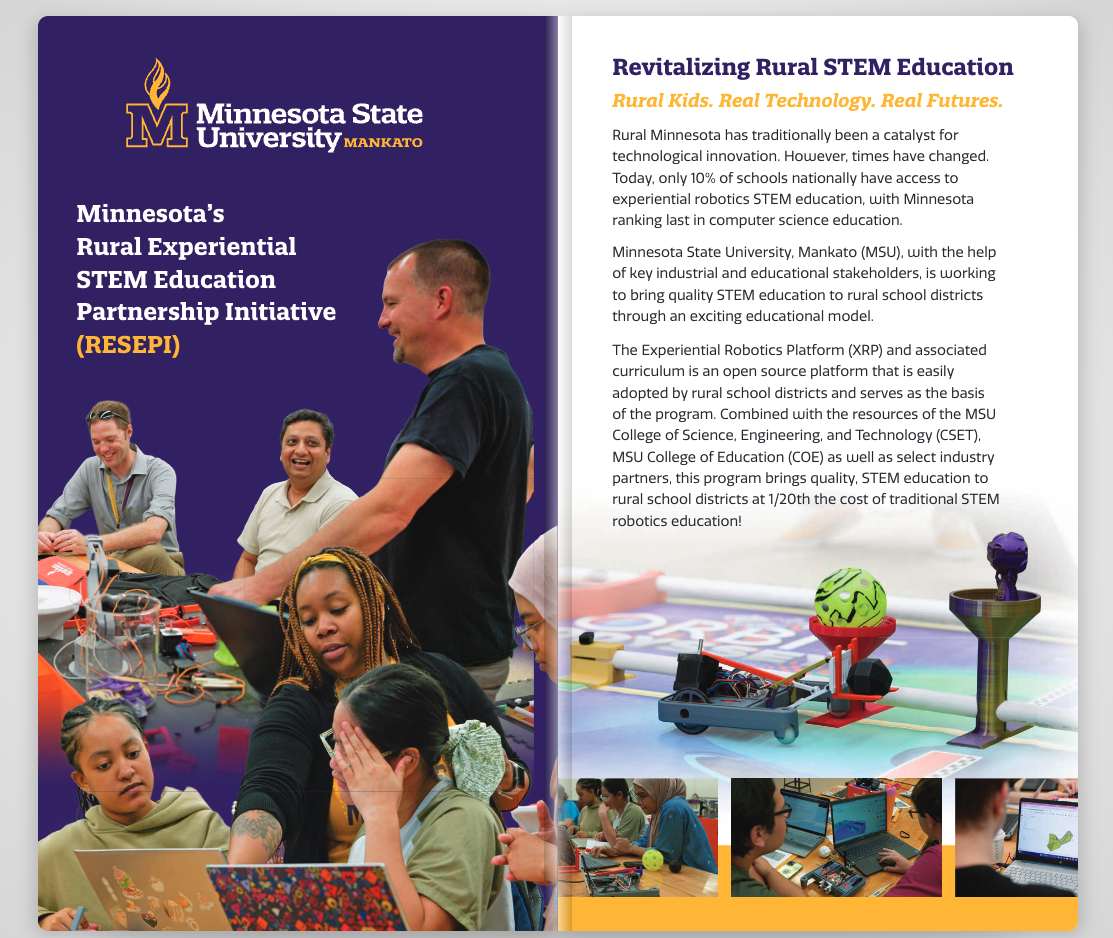
Minnesota State University, Mankato (MSU) is using the open-source Experiential Robotics Platform (XRP) as the foundation of its Rural Experiential STEM Education Partnership Initiative (RESEPI), increasing access to STEM education across rural Minnesota. The initiative brings together the MSU's College of Education and College of Science, Engineering and Technology to provide educators with professional development, instructional technology, curriculum resources, and preservice-teacher support. Starting with three pilot high schools during the 2025–26 school year, RESEPI has grown to serve 12 schools across southern Minnesota. Through XRP’s low-cost platform, RESEPI is making STEM career pathways more accessible and strengthening connections among schools, college, and industry.
So, How Could Your University Use XRP?
If there is anything these examples demonstrate: there is no single formula for how XRP can be used in higher education.
- WPI is using XRP to help expand access to STEM education across the globe.
- Cornell is using it for advanced engineering coursework and experimentation.
- CU Boulder is using it to bring high school students onto campus for project-based learning experiences.
- New Hampshire Community Colleges came together to manufacture and distribute parts and kits that are being used in middle schools and high schools across the state.
- MNSU is using it to bring high quality STEM professional development and instruction to rural schools.
And those are only a few possibilities. These schools assessed their local needs, priorities and resources and put together an impact plan, which involved XRP.
Universities could use XRP to teach robotics and programming, give engineering students a platform for experimentation, develop new hardware and software, run summer camps, train educators, create community outreach programs, or introduce prospective students to engineering and computer science. The approachable starting point is part of what makes that possible. You don't need a huge, complex robotics system to get something moving. But "approachable" doesn't mean limited.
Once the basics are down, XRP can grow into text-based programming, sensors, control systems, computer vision, AI, cyber security, IoT, mechanical design, autonomous systems, and plenty of things we probably haven't thought of yet.
That's the opportunity we see for higher education. If you are already using XRP in higher education, we would love to learn more about your implementation.