Which Current Sensor Do You Need?

Today, we take a closer look at some of our more popular current sensors!
We've recently released some updated current sensors with the INA228 and INA237 Qwiic Current Sensors and the ADE7953 Qwiic Non-Invasive Current Sensor and Kit. With these releases, we realized that we have quite a few different and unique sensors that can measure and output power data, and that it could be a little confusing which sensor could be right for you. So, today, we are going to go over a basic overview of what current is, and the most popular SparkFun Original current sensors that we carry. We even have a video with one of our engineers, Geoff, if you'd prefer to watch instead of reading a long form blog!
Current Sensor Comparison Overview
What is Electrical Charge & Current?
To put it as easily as possible, electricity is the movement of electrons. Electrons create charge, which we can harness to do work. Your lightbulb, your stereo, your phone, etc., are all harnessing the movement of the electrons in order to do work. They all operate using the same basic power source: the movement of electrons.
The three basic principles for this tutorial can be explained using electrons, or more specifically, the charge they create:
- Voltage is the difference in charge between two points.
- Current is the rate at which charge is flowing.
- Resistance is a material's tendency to resist the flow of charge (current).
So, when we talk about these values, we're really describing the movement of charge, and thus, the behavior of electrons. A circuit is a closed loop that allows charge to move from one place to another. Today, though, we are just going to focus on that second point: Current!
Think of the amount of water flowing through a hose from the tank as current. The higher the pressure, the higher the flow, and vice-versa. With water, we would measure the volume of the water flowing through the hose over a certain period of time. With electricity, we measure the amount of charge flowing through the circuit over a period of time. Current is measured in Amperes (usually just referred to as "Amps"). An ampere is defined as 6.241 x 10¹⁸ electrons (1 Coulomb) per second passing through a point in a circuit.
We measure the same amount of pressure at the end of either hose, but when the water begins to flow, the flow rate of the water in the tank with the narrower hose will be less than the flow rate of the water in the tank with the wider hose. In electrical terms, the current through the narrower hose is less than the current through the wider hose. If we want the flow to be the same through both hoses, we have to increase the amount of water (charge) in the tank with the narrower hose.
This increases the pressure (voltage) at the end of the narrower hose, pushing more water through the tank. This is analogous to an increase in voltage that causes an increase in current. If you want to know more about Voltage, Current, Resistance, and Ohm's Law, we have a full tutorial that you dive deeper into by clicking the button below:
Now that we have a better idea of what electrical current is let's take a closer look at the sensors we offer to monitor it!
Digital Current Sensors:
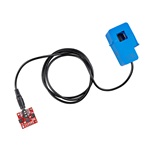
SparkFun Non-Invasive Current Sensor Kit
The SparkFun Non-Invasive Current Sensor Kit gives you everything you need to safely measure AC energy consumption data all via I2C and the Qwiic Connect System. At the heart of this kit is the Qwiic-enabled ADE7953 single-phase multifunction metering IC from Analog Devices, paired with a 100A to 50mA split-core current transformer for a solderless, non-invasive sensor solution.
| Accuracy | Bandwidth | Current | Type | Communication |
|---|---|---|---|---|
| <0.1% (3000:1) / <0.2% (1000:1) | 1.24 kHz | AC | Non-Invasive (Clamp Included) | I2C (Qwiic), SPI, UART |
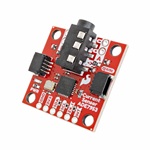
SparkFun Non-Invasive Current Sensor - ADE7953 (Qwiic)
Included in the kit above, the SparkFun Qwiic ADE7953 Non-Invasive Current Sensor makes it easy to monitor the power drawn by AC devices over I2C without disconnecting the circuit or cutting or splicing any wires. The ADE7953 at the heart of this sensor is a single-phase multifunction metering IC that can also measure neutral current on a second channel. It's highly accurate with less than 0.1% error in measuring both active and reactive energy over a dynamic range of 3000:1.
| Accuracy | Bandwidth | Current | Type | Communication |
|---|---|---|---|---|
| <0.1% (3000:1) / <0.2% (1000:1) | 1.24 kHz | AC | Non-Invasive (Clamp Not Included) | I2C (Qwiic), SPI, UART |
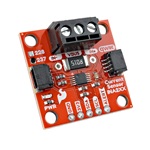
SparkFun Current Sensor - INA237 (Qwiic)
The SparkFun INA237 Qwiic Current Sensor makes it easy to monitor DC current and power with high precision over I2C. It features the INA237 digital power monitor from Texas Instruments, which measures current, bus voltage, temperature, and power for an in-line DC input using a 16-bit delta-sigma analog-to-digital converter (ADC). A 15 mΩ shunt resistor comes pre-populated on the board, but we've also provided through-hole pins for a custom shunt resistor value if needed.
| Accuracy | Bandwidth | Current | Type | Communication |
|---|---|---|---|---|
| 1.6% (Full Scale) | ~9 kHz* | DC | In-Line | I2C (Qwiic) |
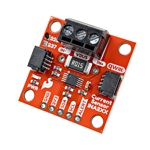
SparkFun Current Sensor - INA228 (Qwiic)
The SparkFun INA228 Qwiic Current Sensor shares the same physical design as our INA237 breakout but features the INA228 digital power monitor from Texas Instruments, which measures current, voltage, power, temperature, energy, and charge accumulation using an in-line 20-bit delta-sigma analog-to-digital converter (ADC). The ADC sets this board apart from most other in-line current sensors by providing incredibly stable, precise readings for highly sensitive electronics.
| Accuracy | Bandwidth | Current | Type | Communication |
|---|---|---|---|---|
| 0.5% (Full Scale) | ~9 kHz* | DC | In-Line | I2C (Qwiic) |
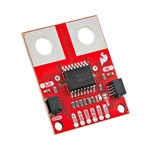
SparkFun Power Meter - ACS37800 (Qwiic)
The SparkFun Power Meter is an "everything is included" power sensing solution built around the Allegro ACS37800 power monitor IC. Designed to also connect to your Qwiic-enabled project, this board allows you to monitor voltage (up to 60VDC) and current (up to 30A) simultaneously without cutting traces or managing complex wiring. It is the perfect tool for tracking power consumption in high-demand systems like 3D printers, UAVs, and solar panels.
| Accuracy | Bandwidth | Current | Type | Communication |
|---|---|---|---|---|
| +/-2% (25°C to 125°C) | 1 kHz | AC/DC | In-Line | I2C (Qwiic) |
Analog Current Sensors:
SparkFun Current Sensor Breakout - ACS723
The SparkFun ACS723 Current Sensor Breakout is a high-accuracy solution for measuring low-to-moderate AC and DC currents. Built around the ACS723 chip, this board is designed to measure current up to 5A with a base sensitivity of 400mV/A. Whether you are monitoring the draw of a small motor or checking the efficiency of a battery charger, this sensor provides a safe, reliable way to obtain the data you need.
| Accuracy | Bandwidth | Current | Type | Communication |
|---|---|---|---|---|
| 1.5% (@ 25°C) | 80 kHz | AC/DC | In-Line | Analog |
SparkFun Current Sensor Breakout - ACS723 (Low Current)
The Low Current version of the last SparkFun Current Sensor Breakout is a high-accuracy board designed specifically for applications that require measuring smaller currents from as low as 10mA to 5A. Built around the ACS723 chip, this board uses a Hall-effect sensor to measure current, providing a safe and reliable way to monitor low-power devices without significantly interrupting the circuit.
| Accuracy | Bandwidth | Current | Type | Communication |
|---|---|---|---|---|
| 1.5% (@ 25°C) | 80 kHz | AC/DC | In-Line | Analog |
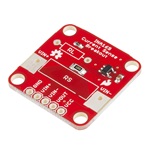
SparkFun Current Sensor Breakout - INA169
The SparkFun INA169 Current Sensor Breakout is a “high-side current monitor,” which means that you place a resistor (a “shunt resistor”) on the positive power rail and the INA169 measures the voltage drop across that resistor. The INA169 outputs a small current based on the measured voltage drop. If you place a resistor from the output of the INA169 to ground, you can measure the voltage at the output.
| Accuracy | Bandwidth | Current | Type | Communication |
|---|---|---|---|---|
| ±0.5% | 220 kHz | AC/DC | In-Line | Analog |
Whether you need to measure the AC energy consumption of a household appliance or precisely monitor the DC draw of a custom microcontroller board, matching the right sensor to your application makes all the difference. Choosing the correct current sensor comes down to your specific power requirements, preferred communication protocol, and whether an in-line or non-invasive setup works best for your circuit. Grab the sensor that fits your specifications, and if you want to learn more about electricity and other engineering foundationals, check the tutorials below!